October 17 / December 20, 2025
COMPORARY ART MODERN PROJECT 2025 / Don’t be Absurd!
The CAMP Gallery North Miami US
The Contemporary Art Modern Project announces its 7th Edition of Women Pulling at The Threads of Social Discourse: Don’t be Absurd. Over 100 years ago Søren Aabye Kierkegaard set the stage for society to look beyond one’s own concerns with the start of Existentialism. Absurdism emerges after the Second World War as the world grappled with the sense of the meaninglessness of life due to an overwhelming indifference for humanity and the suffering of others. For this year’s edition of: Women Pulling at The Threads of Social Discourse, and Guests: Don’t Be Absurd, the exploration of Absurdism is done through the hands of fiber artists. Artists were asked to refer to works by: Albert Camus, Franz Kafka, Simone De Beauvoir, Samuel Beckett, and Jose Saramago and interpret the writings into circular fiber responses.
Le Monde à l’envers
In her novel « All Men Are Mortal, » Simone de Beauvoir tells the story of an immortal man
for whom life no longer has meaning, no way out. He cannot appreciate life because it no
longer has value. He finds himself in an endless cycle where history repeats itself:
conquests of territories, murders, massacres, religions, pillages… Acquiring power to
control, to the point of absurdity makes possession ridiculous and meaningless: the
character withdraws into himself.
Although his encounters with women open other doors (those of love, descendants,
sentiment, the mind, science, the arts), he cannot become attached to them because his
immortal life cannot be reconciled with a mortal life.
Two worlds and two visions clash: that of materialism and that of the mind.
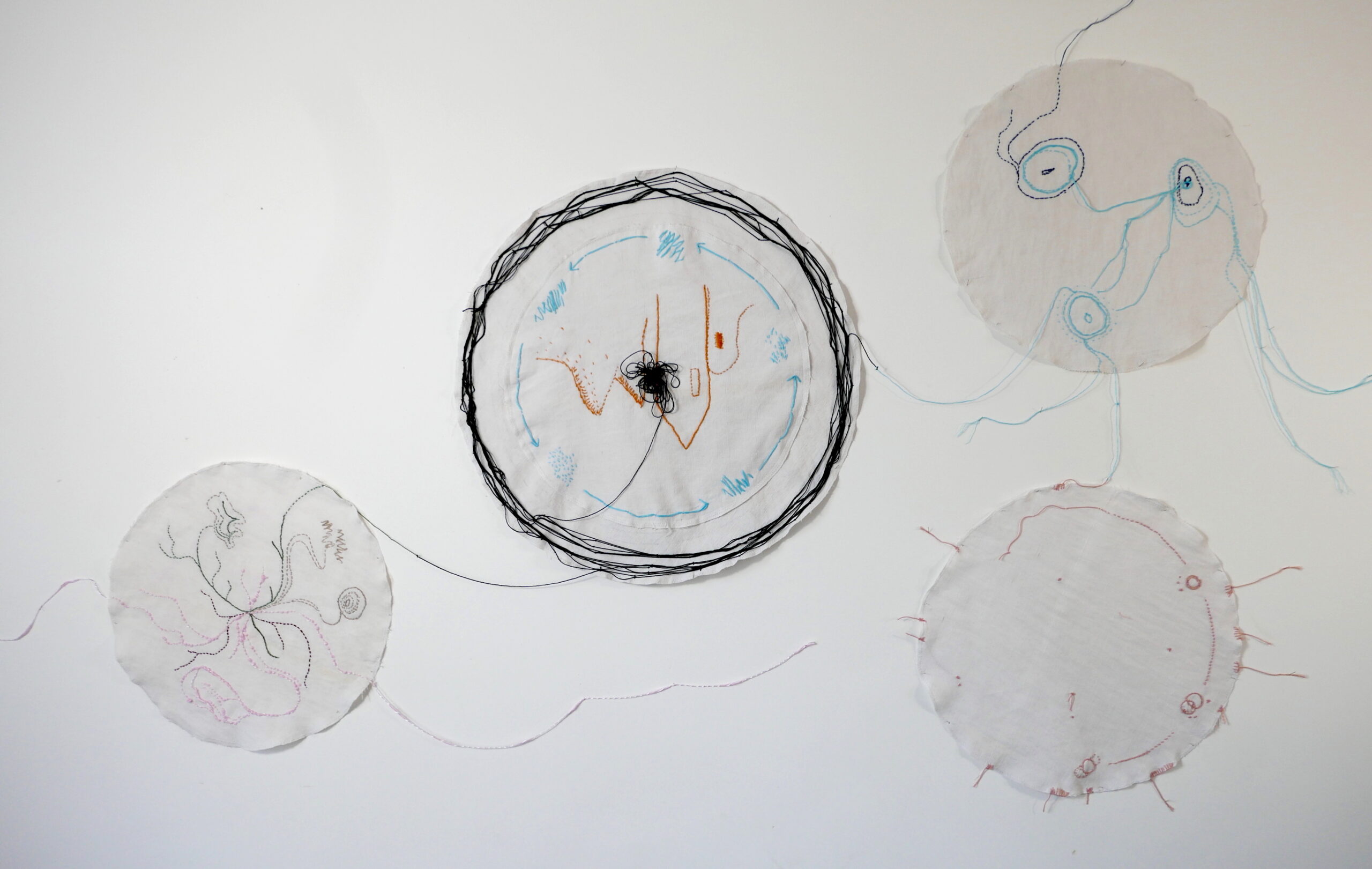
I chose to represent this opposition with four fabric circles that symbolize these two
conceptions of life.
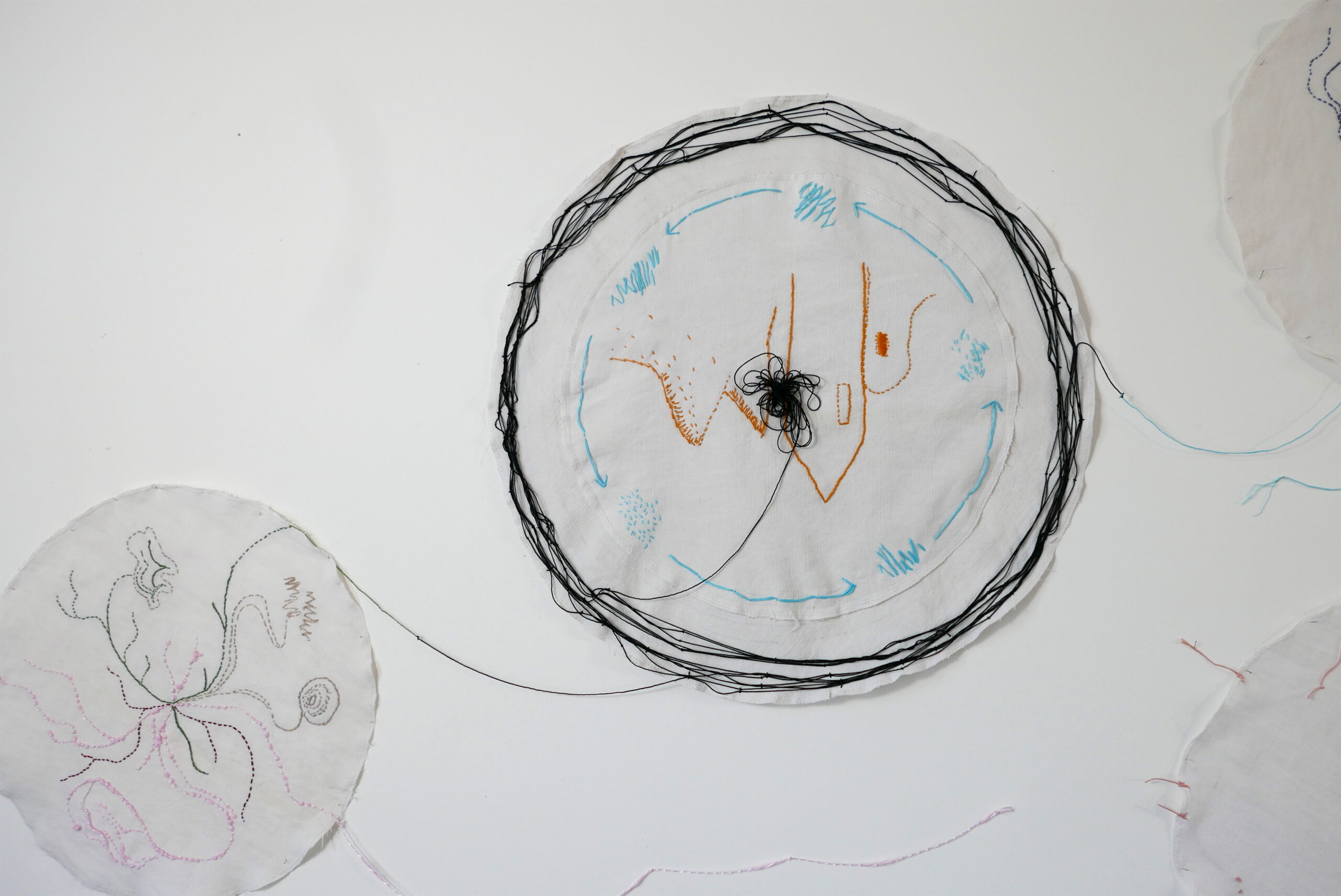
The first 24-inch circle illustrates a world that constantly spins on itself. In the center, black
threads emerge from the fabric: they loop, tangle, knot, and fold back on themselves to
form an increasingly dense knot from which we cannot escape. Above this central knot, we
can make out upside-down dwellings that symbolize the successive places the main
character passes through. All around, a second circle made up of arrows indicates a
perpetual rotation. The repetition and therefore the endless reproduction of the different
motifs in the center generate a centrifugal force, to the point of merging with the
boundaries of the circle. This saturation, symbolizing a frozen world, can only lead to
nausea.
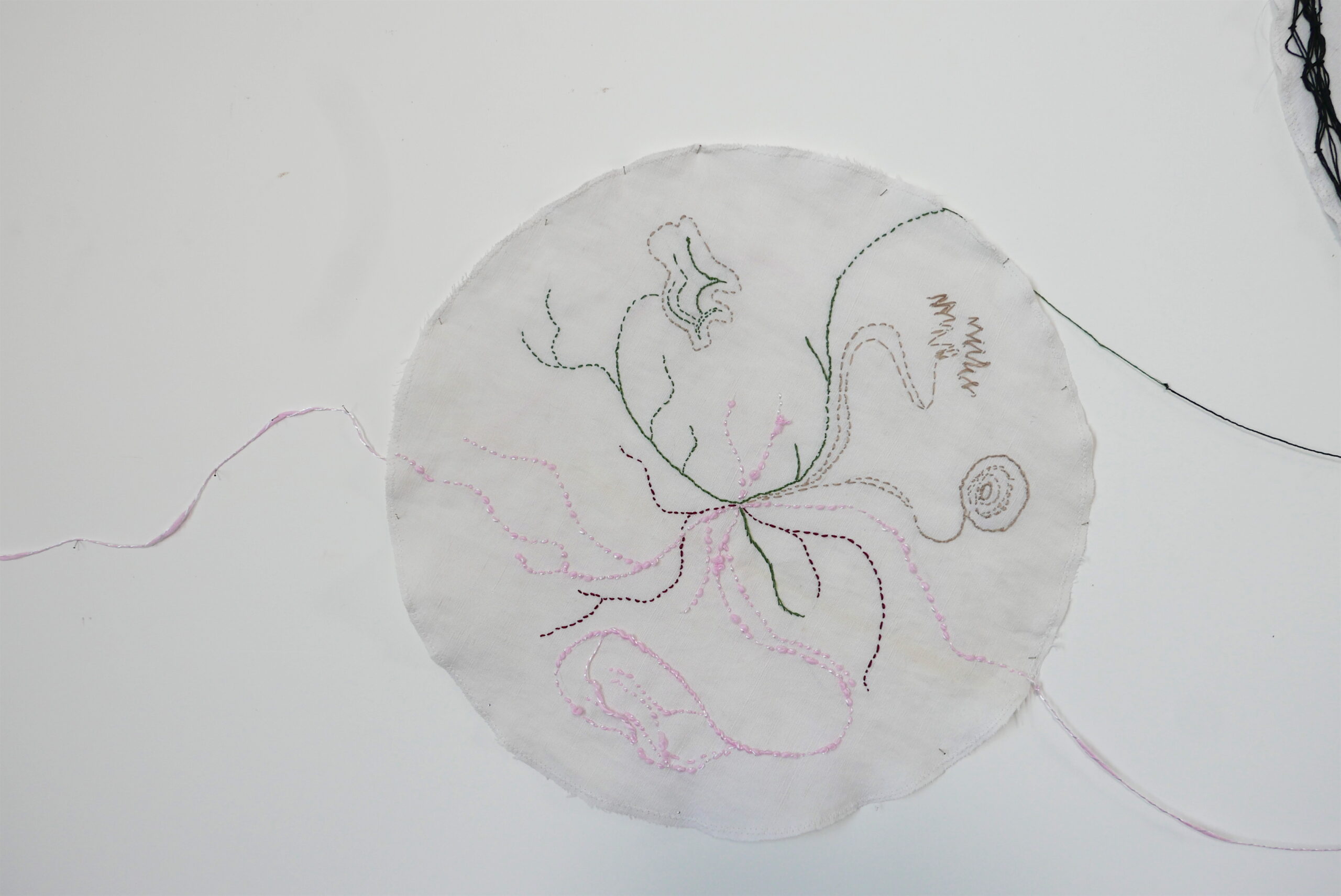
The second world consists of three 18-inch circles. Their size is deliberately identical and
smaller to symbolize an average lifespan. Inside each circle, different embroidered
patterns, paths, and designs symbolize organic and mutated life: the colored threads
inside illustrate the diversity that drives life’s evolution, and those extending outward
suggest future connections.
Le Monde à l’envers
Dans son roman «Tous les hommes sont mortels» Simone de Beauvoir raconte l’histoire d’un homme immortel pour qui la vie n’a plus de sens, plus d’issue. Il ne peut apprécier la vie car elle n’a plus de valeur. Il se retrouve dans un cycle sans fin où l’histoire se répète: conquêtes de territoires, meurtres, massacres, religions, pillages… Acquérir le pouvoir pour contrôler, posséder, jusqu’à l’absurdité rend la possession ridicule et dénuée de sens: le personnage se replie sur lui même.
Bien que ses rencontres avec les femmes ouvrent d’autres portes( celles de l’amour, de la descendance, du sentiment, de l’esprit, de la science, des arts) il ne peut s’y attacher car sa vie d’immortel ne peut se concilier avec une vie mortelle. Deux mondes et deux visions s’opposent: celle du matérialisme et celle de l’esprit
J’ai choisi de représenter cette opposition par quatre cercles de tissu qui symbolisent ces 2 conceptions de la vie.
Le premier cercle de 60cm illustre un monde qui tourne constamment sur lui-même. Au centre, des fils noirs sortent du tissu: ils font des boucles,s’emmêlent, se nouent et se replient sur eux-mêmes pour constituer un nœud de plus en plus dense dont on ne peut pas s’échapper.Au dessus de ce nœud central, on devine des habitations à l’envers qui symbolisent les lieux successifs de passage du personnage principal. Tout autour, un deuxième cercle constitué de flèches indique une rotation perpétuelle. La répétition et donc la reproduction sans fin des différents motifs du centre génèrent une force centrifuge, jusqu’à se confondre avec les limites du cercle.Cette saturation, symbole d’un monde figé ne peut qu’amener à la nausée.
Le deuxième monde est constitué de 3 cercles de 45cm. Leur taille est délibérément identique et plus petite pour symboliser une durée de vie moyenne. A l’intérieur de chaque cercle des motifs, des chemins, des dessins brodés différents symbolisent la vie organique et mutante : les fils de couleur à l’intérieur illustrent la diversité qui fait évoluer la vie et ceux qui partent vers l’extérieur proposent des connexions futures. Sophie PAPIAU 2025